

The Developing Situation
Or, Roland Barthes Waz Ere.

[1]: I hate having my photograph taken. For one thing, I’m not remotely photogenic. My face is more of a panhandler than a moneymaker. But nor am I so hideously deformed that my mug swings back around to being interesting. I’m not a model, and I’m not a monster; I’m just a guy gurning cheesily into the lens, hoping exaggeration will soften the rendered image.
But I do love photography, specifically portraiture. There are only two states in which a person can be photographed: aware and unaware. And, as such, photography is the only medium that can capture the beauty of both a relative truth and an absolute lie.
Point a camera in someone’s face and you’ll elicit a reaction every time. They will either (1) lean into it: smile, pose, ask you to wait two seconds while they fix their hair; or (2) hide: guard their face with their hands or a tea towel or whatever they happen to have about their person, run away, maybe slap the camera out of your hands, in extremis.
If you’re the daring type, you can sometimes sneak a great photograph when your subject isn’t looking. This is risky, maybe even slightly or even massively illegal depending on their state of undress, but a surreptitiously snapped photo can be a work of unfiltered magic, not least because this is one of the only ways to catch a lasting image of a person truly off their guard, with all their defences (and possibly their trousers) lowered. You can observe them directly with your eyes, but as soon as they catch you looking, the game’s up. They will change. They have to change. The camera, however, can steal those precious moments where a person’s wiring is truly exposed. Candid photographs capture an electricity that’s impossible to fake.
Each of us maintains within the vast archive of our psyche a meticulously curated album of identities, one image for every person you know. You are not who you think you are; you are the sum of all the whos you are to all the whos you know. Which is to say that you are never yourself in public, you are yourselves.
If you watch enough people in enough settings for enough time, you come to realise just how much performance we’re all engaged in. Performance, making it up, putting it on—we’re all actors. Our interpersonal relationships are great unstageable dramas, funny and tragic, sometimes riveting, often banal. Great in their depths and their Machiavellian complexities; unstageable in their uniqueness and their opacity to all other spectators.
[2]: My favourite photograph is of my mother. She’s young, in her late 20s. The picture in question was taken, as far as I can gather, at a birthday party for either myself or my sister. There’s a rabble of young children in the foreground, enthralled by some form of in-house entertainment (magicians were big in the nineties). My mother stands against the back wall, staring at the floor, likely enjoying the only moments of peace she’ll experience all day. She couldn’t cope with idleness, always hovering and hoovering after the family. So to see her there, arms folded behind her back, face devoid of expression, is a rare gift.
She hasn’t seen the camera. I know this because she also hated being photographed. This shot is my favourite because it shows something I never saw in the thirty years we had with her: her base state; her real, unperformed self. In that single frame, she’s not a mother or a sister or daughter or a wife, she’s just a person in a room with a dated hairdo.
In capturing her image without her knowledge, whoever took that photograph caught a little shard of her identity I had never seen before, a snapshot within which I can see her without her seeing me.
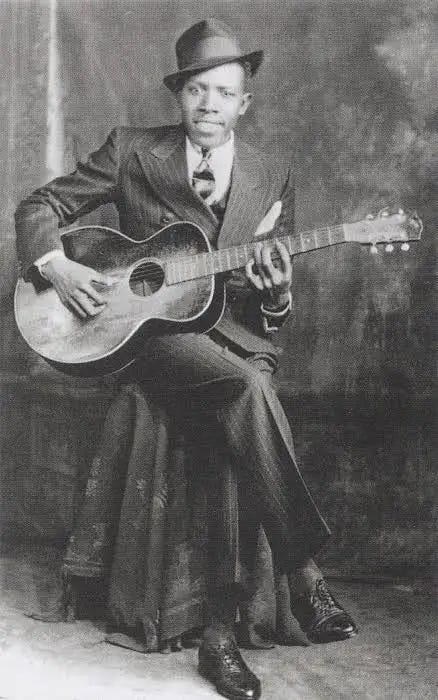
[3]: Pioneering delta blues guitarist Robert Johnson was captured on film only thrice during his tragically short lifetime. Along with his music and some heavily embellished anecdotes re his dealings with a certain collector of souls, those three confirmed snaps are the only evidence that one of the greatest musical talents of all time actually existed.
One of these photos shows the besuited bluesman in a somewhat professional setting: a specialist photography studio in Memphis. He poses, legs crossed, hat devilishly slanted, while fingering a chord on the neck of his battered axe. From his pose and the semi-professional backdrop, we might infer that this was how the man wanted to be seen. He knows the camera is watching, and he clearly permits it--wills it, even--to capture a little of his lightning.
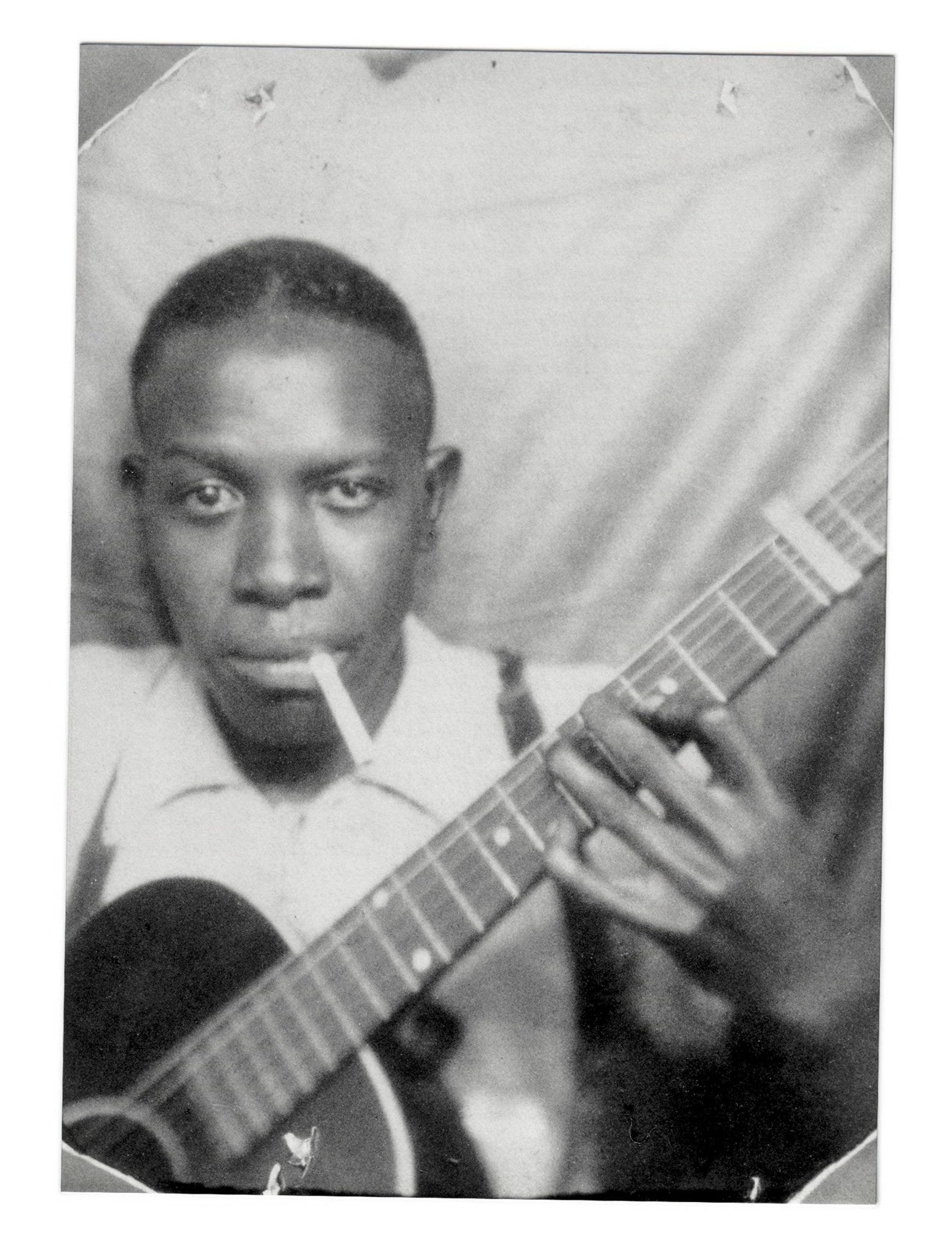
The other two, the so-called “dime-store photos”, were taken in a novelty picture booth. They show Johnson, guitar in hand once again, smoking and smiling. Again, these are not candid photographs--he knows where he is and he also knows where we are--but they feel far less staged. The clothes are more casual this time. The cigarette dangles dangerously from the corner of his Mona Lisa grin. There’s a sense of intimacy here, vulnerability, even irony. Compared with the studio picture, what we’re seeing in the dime-store stills are two more of Robert Johnson’s performed selves: the boyish charm of the youthful journeyman, and the cold glare of the road-worn genius--both doomed; both electric.
[4]: When used sparingly, photography invites us to speculate about a subject in a way no other medium can. A great shot captures a universe within its frame: four dimensions squeezed into two. The viewer is forced to uncompress the information in order to inhabit the frozen moment. Photography then, like painting and, at its best, literature, requires active participation of its audience. Composition, subject, lighting--these are the qualities of proficient camerawork, but the effectiveness of an image has almost nothing to do with those aesthetic properties. A technically excellent picture of a white wall fails as art, whereas the skewed and yellowed daguerreotype of an anonymous urchin breaks one’s heart.
Reconstructing an entire narrative from a single image should be impossible. It is akin to constructing a line from a single point. Yet, that is exactly what happens when we engage with great photography. The mind fills in the blanks, the before and the after. No frame is truly discrete; it is an invitation to embellish an entire continuum of action and meaning. When I look at my mother’s photograph, I envision the next few seconds in which she notices the camera and shyly runs away. In those dime-store pictures of Robert Johnson, I imagine his years thumbing rides to the next juke joint, and I see his youthful body laid out cold in a Mississippi mortuary.
A photograph, then, is an endless reel of film, forever accruing new frames in the minds of those who care to look.
Great essay! I dabble in photography, though I mostly try to capture urban landscapes and still lifes. I am not much of a portraitist, but I do play with filters and exposure before taking the photograph, because what I am really trying to capture is the soul of an image, or the vibe, if you will. My photography is probably more expressionistic than realistic. I try to photograph what is already there, but also to express something I sense beneath the surface. And that is the question: am I capturing the soul of the image, or is the soul already there, waiting to be noticed?