

Let's Fuck!
Blue Velvet Through A Red Lens

WARNING: This essay contains spoilers/analysis for/of the movie Blue Velvet and, tangentially, Twin Peaks and Mulholland Drive! If you haven’t seen them, please, for the love of Maharishi Mahesh Yogi, go watch it before you read this (or even instead of).
The internet loves to speculate about the hidden meaning in David Lynch’s movies. From Twin Peaks to Mulholland Drive to the supposedly impenetrable Inland Empire, there exist fan-theoretic deep dives into most of the auteur’s work. There is one Lynch film, however, that gets far less analytic attention: Blue Velvet (1986).
Blue Velvet is regarded by many as Lynch’s greatest cinematic achievement. Every scene feels absolutely necessary in service to either the plot or the themes. If you took anything out, it would weaken the film’s magic; likewise if you added anything. On a personal level, I view Blue Velvet as being as close to perfect as a real thing can be.
We can skip the obligatory plot summary on account of who the intended audience is for this essay: (1) Lynch fans, (2) fans of film analysis, (3) people with too much time on their hands and too little of interest happening in their real lives and who, therefore, find themselves thinking—and, indeed, overthinking—about the subtext and symbolism and metaphysics of movies and TV shows (AKA me and probably 3 other lunatics in the entire world).
Instead, let’s get straight to the crux of my analysis; let me say it how it is, how it sounds: Blue Velvet is a retelling of and reaction to David Lynch’s experience making Dune (1984). This is not a brand new interpretation, other people have reached the same conclusion before. However, as far as I have been able to find in my research, nobody has actually applied this thematic “key” to the movie itself in an attempt to decipher the symbols and hidden narratives (in, for instance, the way Rosseter applied his TV-meta key to Twin Peaks).
Before we really get into it, let’s make something very clear from the outset: art is all about personal interpretation. If a film or a song or a painting hits you a certain way, you’re not wrong. And, conversely, no matter how well an interpretation is presented or how well it describes aspects of its subject, there are no right answers. Creative analysis is art, not science.
Lynch’s work in particular—by way of its dense symbolic content and (seemingly) absurd presentation—both invites and resists interpretation. Lynch films often refuse to play by the rules of conventional storytelling. And even when they do offer up a seemingly straight story, it’s obvious that there are layers of meaning beneath the surface of linear plot and character development (except, possibly, for The Straight Story (1999), which is, as the name suggests, maybe a genuine straight story).
Blue Velvet does progress linearly for the most part. The naive Jeffrey becomes embroiled in a seedy underworld, solves the mystery, kills the killer, gets the girl (OK, fine—have your obligatory summary). In that sense, Blue Velvet is perhaps Lynch’s most accessible film (or maybe second, see the previous aside re: The Straight Story [which is excellent btw]). But what about Frank’s mask? And what the hell is that scene at Ben’s place? Pretty weird, non?
Lynch’s movies are layered with symbolic meaning—things stand in for other things. Characters and settings represent objects and processes, entire institutions sometimes.
People who don’t “get it” (aka normies) will often accuse surrealists of being “weird for the sake of weird”. And that’s true sometimes. Anyone who grew up in the mid-late 90s surely remembers the “zany”, ironical “thing in the air” that seemed to permeate the language of television and, embarrassingly, advertising. Lynch was a surrealist, but he was not an absurdist (in the sense that things are just thrown in for effect). Every device serves the idea. Meaning exists, and there is beauty and joy in the search for it. “We are all detectives”.
Jeffrey Beaumont is a also detective. The surface level reading of his journey through the narrative is something like a dark bildungsroman, a story of emotional and psychological maturation. When we first meet Jeffrey, he is essentially a boy. Naive to the way people really work—how we use and abuse each other, how dark it get can get out there. By the end of the movie, he has experienced it all first-hand: abuse, control, violence, murder (and most horrifying of all: Pabst Blue Ribbon). By the end, he has had to wrestle with that darkness in order to discover the true value of the light (i.e. his love for Sandy, and the simple life he lives in Lumberton).
A few years before Blue Velvet was made, Lynch helmed the cinematic disaster, Dune. The story of how Lynch lost creative control is infamous, but in brief: Lynch signs on without final cut, meaning “the studio”—those malevolent non-creatives who pull the strings behind the scenes—could fiddle with the edit, the script, the score in any way they pleased. Which they did, famously cutting at least 35 minutes out of the final version. Lynch’s artistic vision was molested, and the resulting hate-baby was the hideously deformed Dune—a movie so ugly not even Sting’s sharp cheekbones could pretty it up.
Lynch is on record as saying he “sold out” on Dune, and was distraught by the time the movie came out, claiming to be “down so far that anything was up!” Undoubtedly, the making of Dune was a traumatic experience for Lynch. For a filmmaker who claimed to be so inspired by darkness and negativity (see Eraserhead [1977] for its atomic subtext and nods to the violence and madness of 70s Philadelphia), how could the failure and trauma of Dune not feature in Blue Velvet, a movie made just two years later?
So what if Jeffrey, on a subtextual level, stands in for Lynch himself? Or maybe just the idea of a filmmaker—one who got involved in something he didn’t truly understand.
Mel Brooks famously hired Lynch to direct The Elephant Man (1980) after watching Eraserhead, and gave him complete creative control—absolute trust. To be handpicked to make a major motion picture based on what was essentially an independent, arthouse flick seems like a dream come true.
The Elephant Man was a resounding success, critically and commercially. A person could come away from a project like that feeling pretty good about themselves. So when Dino De Laurentiis comes knocking at your door, asking you to direct a major motion picture, maybe you think you know what you’re doing, and you say yes, even without the promise of final cut. That’s just business stuff, right? The studio would never really interfere with a director’s vision. Oh, wait!
Lynch comes out the other side of Dune feeling humiliated and disgusted with himself for “selling out”, and he vows to never work that way again, “I would rather not make a film than make one where I don’t have final cut.” Blue Velvet is bankrolled by one same De Laurentiis, but this time, Lynch takes a smaller fee in return for final cut—absolute creative control. As awful as the Dune experience was, a valuable lesson has been learned.
Sounds a bit like Jeffrey Beaumont’s story. A naive boy (Lynch) jumps head first into a seedy underworld (the movie business), watches helplessly as Frank Booth (“the studio”) violates and degrades the object of his obsession, Dorothy (we’ll come back to her but, for now, Dorothy = Lynch’s art), then solves the mystery (learns the value of artistic integrity), and falls in love with Sandy (ideas; the pure intention behind his art).
Don’t worry, I don’t expect to convince anyone with a few vague parentheticals. The Dune meta is simply the key with which I’ll try to unlock some of Blue Velvet’s symbolism.
The most obvious place to start is with the characters. Lynch has a habit of falling in (platonic…mostly) love with certain actors, Kyle MacLachlan being perhaps the most notable. Lynch supposedly showed MacLachlan an early draft of Blue Velvet while they were still working on Dune, so I’m not going to suggest his casting in both lead roles is necessarily meaningful. But it certainly establishes a direct link between the two pictures.
Next up, let’s take a look at Sandy Williams, played by another longterm Lynchian muse, Laura Dern. Sandy. Sand-y. SAND DUNES *cough, cough*.
Dorothy is a complex character. Even in the main narrative, her true motives and conflicts are unclear: she wants her kidnapped family back, but she also seems to get off on Frank’s violence to some extent. For the purposes of this analysis, I’m going to focus more on Dorothy’s attire than her persona or her narrative arc. In the movie, specifically in the scene where we’re first introduced to Frank Booth, Dorothy wears (or dons) a blue velvet robe. Blue Velvet. Lynch’s symbolism is nowhere near as complicated as people like to make out. Twin Peaks essentially tells us directly that “[he] means it as it is; as it sounds”. Hell, in Fire Walk With Me, we’re given a literal guide on how to decode symbols in Lynch’s work (Cousin Lil). So, what does blue velvet—the fabric—stand for in the movie Blue Velvet? Could it be the movie Blue Velvet itself, i.e. David Lynch movies?
Side note: the most widely accepted interpretation of the meaning of blue in the film is something to do with the corruption of innocence, maybe violence itself. That’s fine, I don’t argue. It’s all groovy.
What the fuck is Frank Booth, though? And, for that matter, what is fucking in Blue Velvet?
Names often play an important symbolic role in Lynch’s work. Let’s suppose Booth is meaningful within the framework we’re building up here. Where might we find a booth in relation to the movie business? The box office booth at the entrance of every (old) movie theatre? At least nominally, then, let’s allow Frank Booth to stand in for the box office, i.e. the business end of the movies. What happens when the money men get involved in the creative process? Through their lack of creativity, they’re not able to make things in the same way as the artist. They can’t procreate; they can only fuck. What form does that fucking take in the real world? Messing with the script, the edit—the cut? There’s more to Frank, but let’s move on for now.
Dorothy’s husband and son are both called Don (well, Don & Donny). They’ve been kidnapped by Frank, seemingly held hostage to force Dorothy to obey. I’m hoping you’ve reached the same conclusion there as I did, but just in case: Don = Dune. It’s not even subtle, honestly. Donny is interesting. It’s almost as if Dorothy & Big Don (David Lynch’s art & Dune) have produced Little Don (a new idea? Blue Velvet?).
Jeffrey (Lynch) is in the wardrobe. He watches, helplessly, as Frank Booth (the dark machinations of Hollywood business) gets his (their) freak on with Dorothy (Lynch’s beautiful idea for what Dune could be or Lynch’s beautiful ideas themselves). Seems to work so far, right? What exactly is Frank doing in this scene, though? Is it really sexual?
In an early scene, we enter the movie dream of Blue Velvet through an ear canal. Or is it an ear canal? Could it also be a birth canal? Is the movie Blue Velvet being born in this scene?
“Show it to me”, Frank commands in that scene. Dorothy spreads her legs, showing…what? Her vajayjay? Yes, sure. If Frank really is what I’m suggesting he is, what’s going on here? The position of Frank in relation to Dorothy’s vagina is interesting. Almost looks like someone watching a screen—maybe like how a movie producer might view the dailies/rushes? “Wider”, Frank adds. Dorothy obeys. “Make this shot wider”, the producer demands.
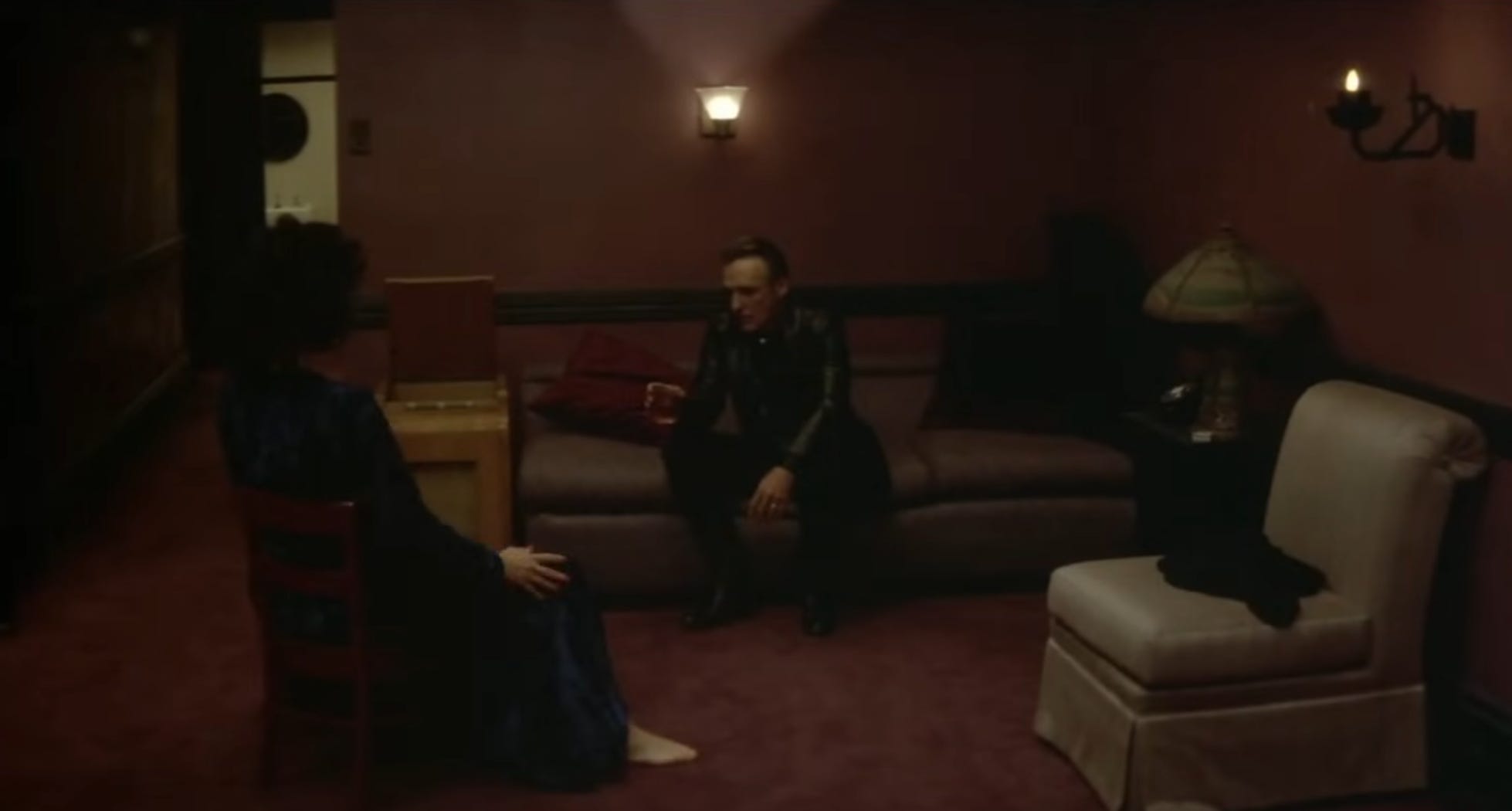
If you pay close attention to Frank’s actions during the nastiest part of the scene, you’ll see something strange happen. Frank stuffs a patch of blue velvet in Dorothy’s mouth. And, if you really pay attention, you can see he’s doing the same thing downstairs. He’s stuffing Dorothy’s blue velvet robe inside her. When Frank straddles her and gives it the old jackhammer action, he’s not even undressed! His trousers are still zipped up. He’s fucking her but he’s not fucking her. He’s forcing blue velvet (aka Blue Velvet aka Dune) out into the real world through the way it came in: via David Lynch’s artistic birth canal. Frank knows exactly what he is. His manic energy is that of a movie business busy body, desperate to rush something, anything out into the world.
We can lean further into this metaphor by looking at Frank’s mask. On the surface, it looks like Frank is getting his groove on with some good old nitrous oxide (laughing gas). I submit to you that what he’s huffing is none other than plain old Gas & Air. As in the analgesic concoction administered to women when they’re in labour. What we have here in this scene is the disgusting, anti-birth of a blue (dead) movie. Induced, prematurely, by studio interference.
Not convinced? OK, let’s move on. In a later scene, Jeffrey returns to Dorothy’s apartment. This time, they make love. Only, it’s not a normal love scene. Dorothy invites Jeffrey to hit her, to engage in Frankish violence. And he does. Jeffrey gives in to the pressure and hits Dorothy. David Lynch caves to studio pressure and does creative violence against his own ideas *cough*.
Need more evidence? Coming up. Let’s skip ahead to Ben’s place. Pretty weird, no? Lynch loves these in between places. The various lodges in Twin Peaks, Club Silencio in Mulholland Drive, the Axxon N. office and the literal movie theatre in Inland Empire. They represent the space between the real world and the movie world—something like a backstage area, the wings. In Blue Velvet, Ben’s place is the realm of the studio exec. This is where the real decisions get made. It’s a place inhabited by creeps and prostitutes (tell us what you really think, Dave).
Frank keeps in his pocket a tape of Roy Orbison’s ‘In Dreams’. A song so perfect for this film you’d be forgiven for assuming it was purposefully commissioned for the soundtrack. Why does Frank have this tape? Because it’s literally the movie’s score. Frank controls every aspect of this “dream”, even the music (Dune’s score was composed by the band Toto [more Wizard of Oz, anyone], but Lynch had no say over the matter). “In dreams, you’re mine, all of the time” Orbison croons. In dreams (studio controlled movies), you (the soundtrack; creative control in general) are mine. Ben’s lip-syncing performance in this scene is diegetic. Both the characters and we the audience can hear the music. We’re backstage, remember. Ben’s place isn’t the movie and it isn’t the real world—it’s both at the same time.
Frank tells us that “[he’ll] fuck anything that moves”. He (the scuzzy movie business people) will fuck (mess with; edit; CUT) anything that moves (moving pictures; Dune). And just to make sure Jeffrey gets the message, Frank disappears—he literally cuts himself out of the movie.
A candy-colored clown they call the sandman
Tiptoes to my room every night
Just to sprinkle stardust and to whisper
Go to sleep, everything is all right.
I probably don’t even need to break this one down, but just for the hell of it: the SAND man (some aspect of Lynch’s self-loathing for the whole Dune debacle) is placated for having violated his own ideas, with candy (money) and stardust (fame). If there’s a better use of a song in the entire history of cinema, please let me know.
Jumping back a scene or two, Frank and Jeffrey meet for the first time outside Dorothy’s apartment. Dorothy tells Frank that Jeffrey is a “neighbour”. Neighbour meaning something like “adjacent to the movie making business”. Then Frank asks/forces Jeffrey to go for a joyride. The director is being held hostage, taken against his will into a world he thinks he wanted. Three guesses who’s driving the car! Also, Raymond—one of Frank’s cronies—produces a knife while they’re in the car. He’s a cutter. He’s the editor. “We might all be killed”, jokes another crony, Paul. Is Paul the screenwriter? Whatever he is, the cronies as a whole stand in for the process of filmmaking. They’re former creatives corrupted by Frank’s evil.
This scene is also where we learn of Frank’s preference for Pabst Blue Ribbon. Jeffrey likes Heineken. Heineken’s logo is a star. Jeffrey, in his naivety, is enamoured by the myth of Hollywood stardom. A blue ribbon might also be called a rosette. Rosettes are awarded to winners. Movie business men love awards. Frank only drinks Blue Ribbon. “Heineken? Fuck that shit”, Franks says. Stardom—cut it out!
After Ben’s, Frank and the boys take Jeffrey out to an abandoned lot. Frank tells Jeffrey, “Don’t look at me, fuck. I shoot when I see the white of the eyes”. Twin Peaks has a whole symbolic thing about the white of the eyes, so I’m going to repurpose that idea here and suggest that it means the same thing in Blue Velvet. The white of the eyes is what we see when a person looks away. Shooting, in this context, could be another form of “fucking”—that is, messing with the cut. It could also literally mean shooting as in filming, as in reshooting. So what is Frank telling us here? He’s saying he messes with your work when you stop paying attention. When you allow yourself to look the other way (when you give up on your vision!!!), Frank will fuck your movie.
“You’re like me”, Jeffrey is told as Frank huffs on his Gas & Air. Then Frank tries to titty twist Dorothy, but she’s wearing the blue velvet robe here. Jeffrey lashes out by punching Frank on the nose. But why is Jeffrey angry? Is he trying to protect Dorothy or her robe? What’s more important to him, his movie or the artistic vision underneath?
Next, Frank slathers himself in red lipstick and kisses Jeffrey. My guess is that this is Jeffrey’s initiation into the seedy movie business underbelly. “You’re like me”. The proceeding “love letter” stuff is possibly a reference to The Scarlet Letter—that is, a very public mark/stain on his (Lynch’s) reputation for selling his soul to the studio. “I’ll send you straight to hell”, Frank says. Also, there’s a chick dancing on the car’s roof. Cool.
Later, Dorothy turns up at Jeffrey’s place stark bollock naked. Why—where’s her blue velvet robe gone? Clue: “he put his disease in me”. And by clue, I mean it’s literally inside her. David Lynch’s movie (Dune, as represented by Blue Velvet, as represented by blue velvet) is gone, it has been released from the dream world. Frank has had his way with it. From this point in the movie, I suppose we’re forced to interpret events as metaphors for what happened after Dune’s release and its subsequent failure.
Jeffrey heads back to Dorothy’s apartment, where he finds the Yellow Man dead but somehow still standing, and Don tied to a chair, finally put out of his misery with one in the dome. The Yellow Man thing I really don’t understand. I think there’s maybe a whole other movie-meta layer going on in Blue Velvet, where blue is something to do with the light of a movie projector. That’s a subject for another tinfoil essay. What’s important is that Don is dead. Dune is dead.
Then Jeffrey kills Frank, or the well-dressed man avatar of Frank (no idea), he makes up with Sandy (gets his creative groove back, commits to his artistic vision), and finally retires in his back yard to watch that weird, obviously animatronic robin in the tree. Why it’s a robin, I’m not sure, other than robins are red. What red symbolises in Blue Velvet is anyone’s guess—passion, love? Whatever—Dorothy is reunited with her son, which I interpret as Lynch regaining creative control. Little Donny grows up to be Blue Velvet or something.
The End.
This is obviously not a complete deconstruction of Lynch’s ideas in Blue Velvet. There’s a lot of weird shit going on in this movie. But I think there’s enough here to warrant a second look. If you find yourself rewatching Blue Velvet, do keep these ideas in mind and see what else you can find. Or maybe jump in the comments and tear my analysis to shreds, I’m fine with being wrong. The clues are more fun than the answers.
Lynch was steadfast in his refusal to explain his work, which I respect immensely. But there are concrete explanations for just about everything in his films, it’s all there if you’re willing to think about it and engage with the art.
P.S. While I was writing this piece, I came across an old interview of Dennis Hopper talking about Frank Booth. He mentions a quote attributed to Van Gogh, “I drank for a whole summer to find that yellow”. Combined with the severed ear Jeffrey finds, is there possibly some allusion to Van Gogh, maybe painting in general, in Blue Velvet? Smells like another essay.
i'll never forget Lynch talking about what a weirdo George Lucas was.
Great read! Never considered any of this, but I imagine it could definitely apply. It happens that earlier this year I listened to the audio version of Room to Dream. It was a fantastic experience. Then I went back and rewatched Blue Velvet. Knowing all the things I learned from the book and having recently seen the movie made your essay even more groovy•